
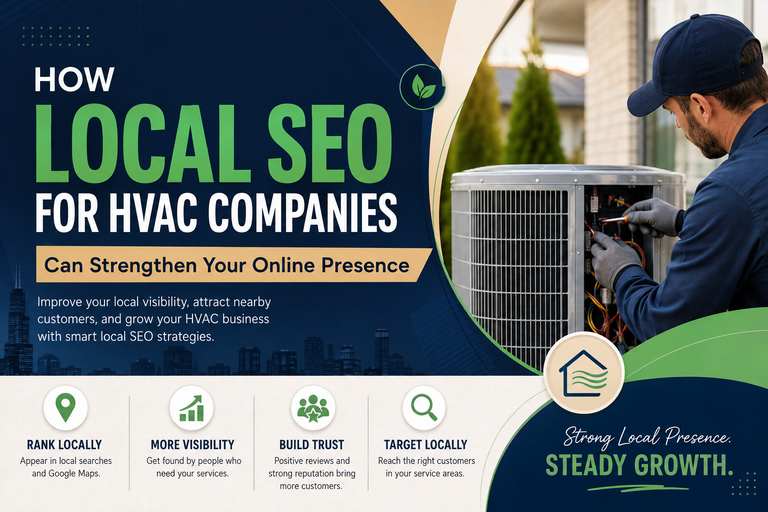
When an air conditioner stops working in the middle of a hot summer day, most people do not have time to search through dozens of websites. They usually open Google and search for an HVAC company nearby. They may type phrases such as “AC repair near me,” “HVAC company near me,” or “furnace repair in [city].” Within seconds, they are presented with local businesses, Google Maps listings, reviews, and websites.
This is where local SEO becomes important for HVAC companies.
Local SEO for HVAC Companies is the process of improving an HVAC business’s online presence so it can become easier to find when people in its service area search for heating and cooling services. It involves much more than adding keywords to a website. A strong local SEO strategy can include Google Business Profile optimization, helpful website content, service pages, local signals, customer reviews, technical improvements, and a clear online presence.
For an HVAC company, the goal is simple: when someone nearby needs heating or cooling help, your business should have a strong chance of appearing in front of that person.
Why Local SEO Matters for HVAC Companies
HVAC is one of the most location-focused service industries. A customer in Dallas, for example, is unlikely to contact an HVAC company that only works in Phoenix. People need technicians who can actually reach their homes or businesses.
Because of this, location plays an important role in HVAC searches. Customers often search for a service and a location together, or they use “near me” searches to find nearby providers.
Local SEO helps search engines understand three important things about an HVAC company: what services it provides, where it operates, and whether it appears to be a reliable business.
Google explains that local results are mainly influenced by relevance, distance, and prominence. This means an HVAC business needs to provide accurate information while also building a trustworthy and useful online presence.
Local SEO can also help businesses reach people at the moment they have a real need. Someone researching general HVAC information may not be ready to contact a company. Someone searching for “emergency AC repair near me,” however, may already be looking for help.
That difference makes local search especially valuable for HVAC businesses.
Start With Your Google Business Profile
One of the first areas an HVAC company should focus on is its Google Business Profile.
Your Business Profile can appear when people search for your company or for HVAC services in your area. It can also appear in Google Maps, giving potential customers quick access to important information about your business.
The profile should accurately represent the real business. Your company name, phone number, website, business hours, category, service information, and service area should all be kept up to date.
HVAC companies that travel to customers can also use Google’s service-area business options where appropriate. This is useful for companies that do not serve customers at a traditional storefront but send technicians to homes and businesses.
Photos can also make the profile more useful. Instead of relying only on generic images, consider adding real photos of your technicians, vehicles, equipment, completed HVAC work, office, and team.
These details give potential customers a better idea of who they may be dealing with.
It is also important not to manipulate the business name by adding extra keywords or city names that are not part of the real-world business name. Accurate business information helps create a more trustworthy local presence.
Build Service Pages That Answer Real Questions
A common mistake on HVAC websites is putting every service into one general page.
Imagine a homeowner searching for furnace repair. They land on a page that talks about AC installation, duct cleaning, heat pumps, indoor air quality, and ten other services without clearly explaining furnace repair.
That creates a poor experience.
Instead, an HVAC website should have clear pages for its main services. If the company provides AC repair, furnace repair, HVAC maintenance, heat pump installation, ductwork, or commercial HVAC services, those services can have dedicated pages when there is enough useful information to explain them properly.
A good service page should not simply repeat a keyword.
It should explain what the service involves, what problems customers may experience, when professional help may be needed, what the process generally looks like, and what customers should consider when choosing a contractor.
For example, an AC repair page could discuss common symptoms such as poor airflow, unusual noises, warm air, frequent cycling, or water leaks. It can explain that different problems have different causes and that a qualified technician should diagnose the system before recommending a repair.
This type of information is more useful than writing a page that repeats “AC repair” dozens of times.
Google recommends creating helpful, reliable, people-first content rather than content created mainly to manipulate search rankings.
Create Local Content That People Actually Want to Read
Blog content can support an HVAC company’s local SEO strategy, but the content needs to serve a purpose.
Instead of publishing dozens of short articles with little value, focus on questions that homeowners and property managers genuinely ask.
An HVAC company could publish articles about why an air conditioner is blowing warm air, how often an HVAC system should be maintained, when a furnace may need replacement, how to prepare an HVAC system for winter, or what signs may indicate a problem with a heat pump.
These topics can attract people who are researching HVAC problems before deciding what to do next.
Local content can also be useful when it naturally connects an HVAC topic with the communities the company serves. For example, an HVAC business in a region with very hot summers could publish educational content about preparing an AC system before the hottest months.
The key is to avoid writing content simply because a keyword has search volume.
A useful article should answer the reader’s question clearly and provide information they can actually use.
Over time, this can help an HVAC website build topical relevance while also giving potential customers a reason to trust the business.
Use Location Pages Carefully
Many HVAC companies serve multiple cities or communities. This can create an opportunity for location-focused pages, but these pages should be created carefully.
A page titled “HVAC Services in [City]” should contain more than a changed city name.
It should provide information that is genuinely relevant to customers in that area. The page can explain which HVAC services are available, what types of properties the company serves, how customers can contact the business, and what makes the company familiar with that service area.
If an HVAC company genuinely operates across several locations, unique and useful location pages can make sense.
However, creating hundreds of nearly identical pages for cities where the company does not really operate is not a good SEO strategy.
The same principle applies to “near me” searches. You do not need to repeat “near me” throughout your website. Search engines can understand geographic relationships and local intent without unnatural keyword repetition.
Customer Reviews Can Strengthen Local Trust
Imagine two HVAC companies appearing next to each other in a local search.
One has a strong collection of genuine customer reviews with thoughtful responses from the business. The other has very little feedback.
Many customers will naturally feel more comfortable learning about the company with stronger evidence of real customer experiences.
Reviews are therefore an important part of a local presence.
After completing legitimate HVAC work, businesses can ask customers to share honest feedback. When customers leave reviews, the company should respond professionally.
Positive reviews can be acknowledged with a simple thank-you. If a customer leaves a negative review, the response should remain calm and helpful rather than becoming an argument.
Google notes that responding to reviews can show customers that a business values their feedback.
HVAC companies should never create fake reviews or pay for misleading feedback. Genuine customer experiences are much more valuable for building long-term trust.
Show Experience and Expertise
HVAC work involves technical knowledge, equipment, safety considerations, and practical experience. Your website should make that expertise visible.
This does not mean filling every page with complicated technical language.
Instead, explain who is behind the business and why customers can trust the company.
An HVAC website can include an About page that introduces the company, its experience, its team, its service areas, and relevant professional qualifications where applicable.
Educational content can also demonstrate knowledge. If your technicians have experience working with different systems, explain common problems and maintenance considerations in a clear way.
Google’s guidance around E-E-A-T focuses on experience, expertise, authoritativeness, and trustworthiness. Trust is especially important, and websites should make it clear who created the content and why the information can be relied upon.
For HVAC content, this can be especially useful when discussing technical or safety-related topics.
Make Your HVAC Website Easy to Use
SEO can bring visitors to your website, but the website still needs to help them.
Think about what happens when someone visits your website from a phone.
Can they immediately understand what your company does? Can they find the areas you serve? Is the phone number easy to locate? Can they quickly find AC repair or heating services?
A good HVAC website should make these answers clear.
Mobile usability is particularly important because many local searches happen from smartphones. A visitor who has to zoom in, wait for a page to load, or search through confusing menus may leave before contacting the company.
Keep the navigation simple and make important information easy to find.
Page speed also matters for the overall user experience. Large images, unnecessary plugins, poor hosting, and excessive scripts can slow down a website.
Google recommends considering page experience alongside helpful content and other SEO fundamentals.
Build Relevant Local Authority
Local SEO is not limited to your own website.
Search engines can also discover information about businesses from other websites and sources. This makes local mentions and relevant links useful parts of a broader SEO strategy.
For an HVAC company, relevant opportunities may come from local organizations, community websites, industry associations, manufacturers, suppliers, local publications, and legitimate business directories.
The focus should be relevance rather than quantity.
An HVAC company does not need hundreds of random links from unrelated websites. A smaller number of relevant, trustworthy mentions can make more sense for a local business.
Avoid link schemes that promise large numbers of backlinks for a very low price. These tactics can create more risk than value.
Keep Your Business Information Consistent
Imagine your website says your company closes at 6 PM, while another online listing says it closes at 9 PM.
A potential customer may not know which information is correct.
Consistent business information helps customers and search engines understand the company.
Keep your business name, phone number, website, address or service area, and other important details accurate wherever your company has a legitimate online listing.
When information changes, such as business hours or contact details, update the relevant profiles and website.
This may sound simple, but small inconsistencies can create unnecessary confusion.
Measure Your Local SEO Progress
SEO should not be based only on whether a business owner sees their website ranking for one search.
Search results can vary by location, device, search history, and other factors.
Instead, track broader performance.
Google Search Console can provide information about search impressions, clicks, queries, and page performance. Website analytics can help you understand how visitors behave after arriving on the site.
You can also monitor leads, phone calls, form submissions, and other meaningful business actions.
Remember that indexing and ranking are not the same thing. Google explains that meeting technical requirements does not guarantee that a page will be crawled, indexed, or shown in search results.
That is why a long-term SEO strategy should focus on technical health, useful content, strong local signals, and a good experience for visitors.
Common Local SEO Mistakes HVAC Companies Should Avoid
Some HVAC businesses make local SEO harder than it needs to be.
One common mistake is creating thin service-area pages with almost identical content. Another is stuffing keywords into every paragraph. Some businesses also ignore reviews, leave their Google Business Profile incomplete, or publish blog posts that provide very little useful information.
Another problem is creating pages for areas where the company does not actually provide services.
These approaches may seem like shortcuts, but they do not create a strong online presence.
A better approach is to build fewer, stronger pages that accurately represent the company and genuinely help potential customers.
Frequently Asked Questions
What is local SEO for HVAC companies?
Local SEO for HVAC companies is the process of improving an HVAC business’s online presence so it can be discovered by customers searching for heating and cooling services in its service area. It includes website optimization, Google Business Profile management, reviews, local content, service pages, and other local SEO activities.
Why do HVAC companies need local SEO?
HVAC services are location-based. Customers normally want a technician who can reach their home or business. Local SEO helps businesses become more visible when people search for HVAC services in the areas they serve.
Does Google Business Profile matter for HVAC SEO?
Yes. A properly managed Google Business Profile can help customers discover an HVAC business through Google Search and Maps. Google states that local results are primarily influenced by relevance, distance, and prominence.
Should HVAC companies create a page for every city?
Not necessarily. Location pages should be created when a company genuinely serves those areas and there is enough useful information to make each page valuable. Creating many duplicate pages with only the city name changed is not a strong approach.
How long does local SEO take for an HVAC company?
There is no guaranteed timeline. Results depend on the competition, location, website condition, existing authority, content quality, reviews, Business Profile, and consistency of the SEO work.
Can an HVAC company do local SEO on its own?
Yes. Business owners can handle many basic SEO tasks themselves using Google’s documentation and available tools. However, SEO can become time-consuming as a business grows, especially when technical SEO, content, local optimization, and performance tracking all need regular attention.
Final Thoughts
Local SEO for HVAC Companies is not about finding a shortcut to the top of Google. It is about building a useful and trustworthy online presence that makes it easier for local customers to discover your business.
Start with the basics. Make sure your Google Business Profile is accurate. Create useful service pages. Publish helpful HVAC content. Build genuine customer reviews. Keep your local information consistent. Make your website fast and easy to use. Then monitor the results and improve the areas that need attention.
A strong local SEO strategy takes time, but it can become an important part of an HVAC company’s long-term online presence.
If you want help building and managing a local SEO strategy for your HVAC business, SparkFilter can help. Our approach focuses on the areas that matter for local visibility, including website optimization, service content, local SEO, Google Business Profile optimization, and ongoing performance improvement.
Contact SparkFilter today to discuss your HVAC SEO goals and create a strategy that fits your business and service area.